

The CMDB Delusion, Why Your "Single Source of Truth" Is a Lie
Organizations spend millions maintaining accurate CMDBs that have zero impact on actual change decisions. Here's why.

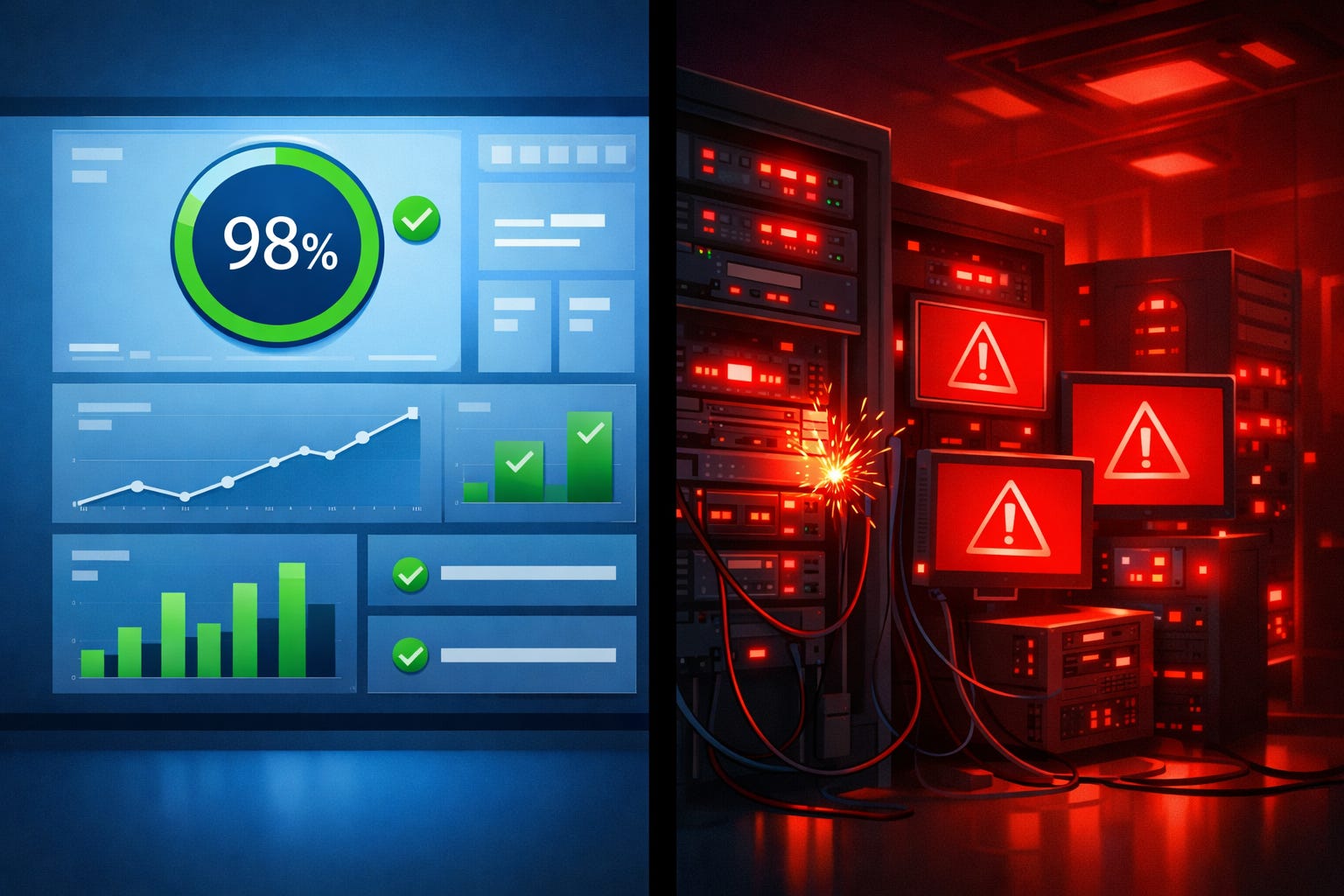
The Green Dashboard and the Burning Server
There is a specific kind of irony that every IT leader knows…
It’s the moment you sit in a steering committee meeting, projecting a dashboard that shows your Configuration Management Database or CMDB health at 98% accuracy. The squares are green. The compliance metrics are optimal. The auditors are happy.
And then, at 2:00 PM, a critical application goes down.
The Major Incident Management or the MIM team opens a P1 incident bridge to isolate the issue and find remediation… and on the bridge an engineer tries to trace the dependency to find out what else might be affected. They query the CMDB. The system says there are no downstream dependencies. They reboot the server.
The application comes back up. But the payment gateway stays down. Because the CMDB didn’t know the payment service was hosted on a container that lived on that server. Or maybe it knew, but the record hadn’t been updated in six months. Or maybe the field was there, but no one trusted it enough to look.
The dashboard is still green of course... The business is still bleeding.
This is the CMDB delusion.
Industry analysts estimate that up to 85% of CMDB initiatives fail to deliver expected value. Yet organizations continue to invest millions in tools, consultants, and processes to maintain them. We treat the CMDB as a foundational pillar of IT Service Management. We mandate that every asset be recorded. Every relationship mapped. Every attribute validated.
But if you ask the engineers who actually fix the incidents, you get a different answer. They don’t trust it. They don’t use it. They bypass it.
The problem isn’t the tool. The problem is the belief that accuracy equals utility. We are building perfect maps of a territory that changes every day. And we are wondering why no one uses the map when the ground is shaking.
The Micro-View: A Change Request, Ignored
To understand the delusion, we have to look at the work. Not the compliance reports, but the actual decision-making process.
Let’s walk through a standard Change Advisory Board or the CAB meeting. This is where the CMDB is supposed to shine. It’s supposed to tell us risk. It’s supposed to show dependencies.
On the CAB …
9:00 AM: The CAB convenes. There are approx. 40 changes on the agenda. The meeting is scheduled for one hour. That means each change gets 90 seconds.
9:05 AM: Change Request #5042 comes up. “Patch deployment for Database Cluster A.” The change owner presents the plan. It looks standard. Low risk. Routine maintenance.
9:07 AM: The Change Manager asks the required question: “Have you reviewed the CMDB for dependencies?”
The change owner nods. “Yes. No critical dependencies flagged.”
They are telling the truth. They did query the CMDB. The CMDB said there were no critical dependencies. So the change is approved. It moves to implementation.
2:00 PM: The patch deploys. The database cluster reboots.
2:03 PM: The billing system goes offline.
2:15 PM: The post-mortem begins. An engineer digs into the architecture. They find that the billing system pulls a nightly batch job from Database Cluster A. It’s a hard-coded connection. It’s not in the service model. It’s not in the CMDB.
3:00 PM: Someone updates the CMDB record. They add the dependency. They mark the relationship as “Critical.”
The CMDB is now more accurate than it was at 9:00 AM. But the value wasn’t there when the decision was made.
This is the cycle. We update the CMDB after the incident, not before the change. We treat it as a system of record, not a system of engagement. It becomes a graveyard of past decisions, not a tool for future ones.
And yet, we continue to measure success by accuracy metrics. “Are all fields populated?” “Is the discovery scan running?” “Is the compliance score above 95%?”
We are measuring the cleanliness of the library while the house burns down.
The Accuracy Trap
Why do we keep doing this? Why do we chase 100% accuracy for 100% of assets?
Because it feels safe. It feels like control.
If we can just document everything, we tell ourselves, we can manage everything. If we know every server, every application, every relationship, then nothing can surprise us.
But IT environments are not static. They are fluid. In modern organizations, infrastructure is code. Containers spin up and down in minutes. Serverless functions exist only when triggered. Cloud resources are provisioned via API calls that never touch a change ticket.
To maintain 100% accuracy in this environment requires 100% automation. And even with automation, there is latency. There is context that tools cannot see.
I have seen organizations hire teams dedicated solely to CMDB hygiene. Their entire job is to chase engineers to fill out fields. To validate relationships. To close out discovery discrepancies.
This is waste.
It is waste because the effort is disproportionate to the value. Do you need to know the exact RAM configuration of every developer’s laptop to manage risk? No. Do you need to know which database supports your revenue-generating application? Yes.
But the CMDB model treats them the same. Every asset is a configuration item (CI). Every relationship is a dependency. The model demands uniformity. The reality demands prioritization.
This is the Accuracy Trap. We spend 80% of our effort maintaining data for assets that carry 5% of the risk. And then we wonder why the critical 5% is still outdated.
When engineers realize this, they stop trusting the system. They know the CMDB is a compliance tool, not an operational tool. So when an incident happens, they don’t open the CMDB. They open Slack. They call the person who built the system. They look at the code repository.
They go to the source of truth that actually works.
The Compliance vs. Operations Divide
There is a deeper reason the CMDB fails. It is built for two different masters, and they want different things.
Master 1: The Auditor.
The auditor wants completeness. They want to know that every asset is accounted for. They want to see that licenses are compliant. They want to see that security patches are tracked. For the auditor, the CMDB is a ledger. It is historical. It is about liability.
Master 2: The Operator.
The operator wants speed. They want to know what breaks if I pull this plug. They want to know who to call when the alert fires. For the operator, the CMDB is a map. It is real-time. It is about survival.
Most CMDB implementations are designed for the auditor.
The fields are chosen based on asset management requirements, not incident response needs. The workflows are designed to prevent unauthorized changes, not to enable rapid diagnosis. The governance is designed to protect data integrity, not to facilitate usage.
When you build for the auditor, you create friction for the operator. You require approvals to update records. You mandate fields that don’t matter for troubleshooting. You lock down access to protect data quality.
The result is a system that is accurate enough for compliance, but useless for operations.
I have sat in meetings where a Change Manager refused to approve a critical fix because the CMDB record wasn’t updated. The system was down. Customers were affected. But the process demanded the record be correct first.
That is the moment the delusion breaks. That is the moment you realize you are serving the map, not the territory.
What Teams Actually Need (Not What Vendors Sell)
I have spoken to dozens of platform engineers, incident managers, and IT directors about this. I didn’t ask them about their CMDB strategy. I asked them about their trust.
Here is what they keep saying. These are not requests for better discovery tools. They are requests for better decision support.
“Tell me what breaks, not what exists.”
They don’t need a list of all servers. They need a list of the critical dependencies for this service. They want impact analysis, not asset inventory.“Let me trust the data without verifying it.”
If the CMDB says a dependency exists, I want to believe it. Right now, I have to call the owner to confirm. If I have to confirm it, the CMDB didn’t save me time.“Update it when the work happens, not after.”
They want discovery that runs during deployment. If Terraform provisions a resource, the CMDB should know immediately. Not tomorrow. Not after a scan. Now.“Hide the noise.”
They don’t want to see 500 relationships. They want to see the 3 that matter. They want risk-weighted dependency mapping, not a spiderweb of every possible connection.“Let me fix it without permission.”
During an incident, they want to be able to update a record without a change ticket. They want to mark a service as “degraded” without a governance workflow. Speed over compliance, temporarily.
These requests point to a shift in philosophy. The CMDB should not be a library. It should be a cockpit.
It should show you only the instruments you need to fly the plane. It should update automatically. And it should be trusted enough that you don’t second-guess it when the alarm sounds.
A Diagnostic for Trust: The “Ignored Field” Audit
You do not need to migrate platforms to fix this. You do not need to buy a new discovery tool. You need to assess trust.
Run this exercise with your incident management and change management teams. It takes about 30 minutes.
The “Ignored Field” Audit
Pick the Last Major Incident. Choose something significant from the last quarter. A P1 or P2 that required cross-team collaboration.
Pull the Post-Mortem. Look at the timeline. Look at the diagnostic steps.
Identify the Data Gaps. Where did engineers have to search for information? Did they ask “What else runs on this host?” Did they ask “Who owns this service?” Did they ask “When was the last change?”
Check the CMDB. For each question, check if the answer existed in the CMDB at the time of the incident.
If the data was there but unused: Trust Issue.
If the data was missing: Coverage Issue.
If the data was wrong: Accuracy Issue.
Calculate the Ratio. How many critical questions were answered by the CMDB vs. human interaction?
If the ratio is less than 50%, your CMDB is a compliance tool, not an operational tool.
Bonus: For every Trust Issue, ask: “Why didn’t they look?” Was it too slow? Was it hard to find? Had it been wrong before?
This audit will not give you an accuracy percentage. It will give you a trust percentage. And trust is the only metric that matters.
Do this once a quarter. Track the trust score. If it doesn’t go up, stop investing in accuracy. Start investing in utility.
The Path Forward: From Record to Resource
So where do we go from here? Do we delete the CMDB?
No. We still need asset management. We still need compliance. But we need to stop pretending that a comprehensive CMDB is the goal.
The goal is critical data utility.
This means accepting that some data will be stale. It means accepting that 100% coverage is impossible. And it means focusing all your energy on the 10% of assets that drive 90% of your risk.
Start by identifying your critical services. Not your critical servers. Your critical services. The ones that generate revenue. The ones that impact customer safety. The ones that define your brand.
For those services, demand 100% accuracy. Demand real-time discovery. Demand automated validation. Make it impossible for the data to be wrong.
For everything else? Let it go.
Allow approximate data. Allow manual updates. Allow decay. Do not waste engineering cycles maintaining records for non-critical assets.
This is heresy in traditional ITSM. It violates the principle of uniformity. But it aligns with the principle of value.
When you do this, something shifts. Engineers start to trust the system again. Because when they look up a critical service, the data is right. When they run an impact analysis, the results are usable.
The CMDB becomes a resource, not a record. It becomes something they use, not something they endure.
The Real Work Ahead
We are in an era where AI is being pitched as the solution to CMDB failure. Vendors tell us that AI will auto-map dependencies. AI will clean the data. AI will predict risk.
But AI amplifies good data—and it amplifies bad data faster. If you feed AI a delusional CMDB, you will get confident, wrong answers at scale.
The real work ahead is not implementing AI. It is defining what matters.
It is sitting down with your business leaders and asking: “What services actually matter?” It is having the courage to say: “We will not track everything. We will track what matters.”
It is shifting the metric from “Accuracy” to “Usage.” If no one uses a field, delete it. If no one queries a relationship, remove it.
This is hard work. It requires saying no to auditors. It requires saying no to vendors. It requires saying no to the comfort of a green dashboard.
But it is the only way to close the gap between the map and the territory.
So here is my ask. Look at your CMDB. Not the dashboard. The usage logs.
When was the last time an engineer used it to solve a problem faster? When was the last time it prevented an outage? When was the last time it was the source of truth that everyone trusted?
If you can’t answer that, you don’t have a CMDB problem. You have a delusion problem.
And the only cure is to stop polishing the map and start fixing the terrain.
A Question for You
I am curious about your experience. When was the last time you relied on your CMDB during a major incident? Did it help, or did you bypass it?
Reply and tell me. I am collecting these stories to understand where the trust actually lies. Not in the tool. But in the work.

Let’s stop measuring accuracy. Let’s start measuring trust.
Support Independent ITSM Writing
« This publication is reader-supported.»
I write to explore the evolving role of IT service management, leadership, and alignment — not from a vendor lens, but from real operational and executive experience.
You’re welcome to read for free. Always.
If you find value in these reflections and want to support deeper, more frequent writing, consider a paid subscription. It costs less than a cup of coffee per month, and it helps sustain thoughtful, independent work — without advertising or hype.
Either way, I’m glad you’re here.
Cheers,
𝓦𝓪𝓼𝓮𝓮𝓶